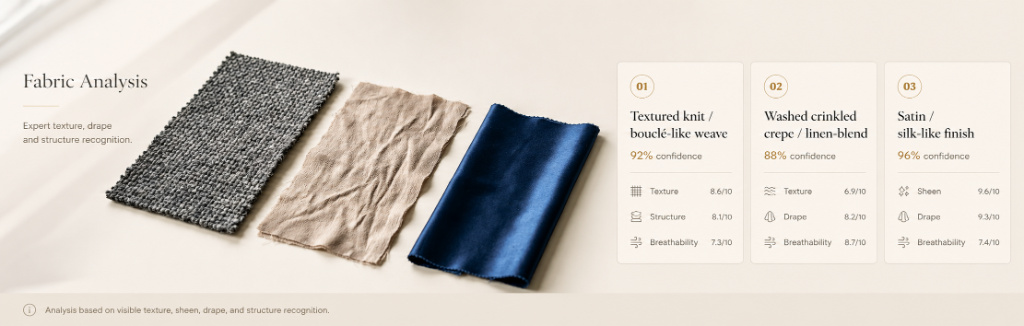
Atelia turns fibre composition into lived experience. Drape, breathability, durability, maintenance, and price-fairness. Not "polyester is bad." Contextual tradeoffs, explained the way an experienced buyer would explain them.
Photos are styled. Descriptions are written by marketers. Prices reflect brand, not always fibre. Composition is the one piece of the label that has to be true. Atelia reads it carefully, and translates it into what wearing the garment will actually feel like.
How the fibre falls. How it holds shape across long wear. Whether it reads as fluid, architectural, or somewhere in between. Drape is half the silhouette.
How the garment performs across temperatures and hours of wear. Wool insulates dry warmth. Synthetics trap heat. Linen breathes but creases. Context matters.
How the fibre wears across years. Natural fibres age gracefully but pill. Synthetics resist abrasion but pill plastic. Atelia models cost-per-wear, not just price.
How much of your life this garment will quietly demand. Dry-clean-only is a recurring cost. Iron-friendly is a freedom. Atelia surfaces the upkeep before purchase.
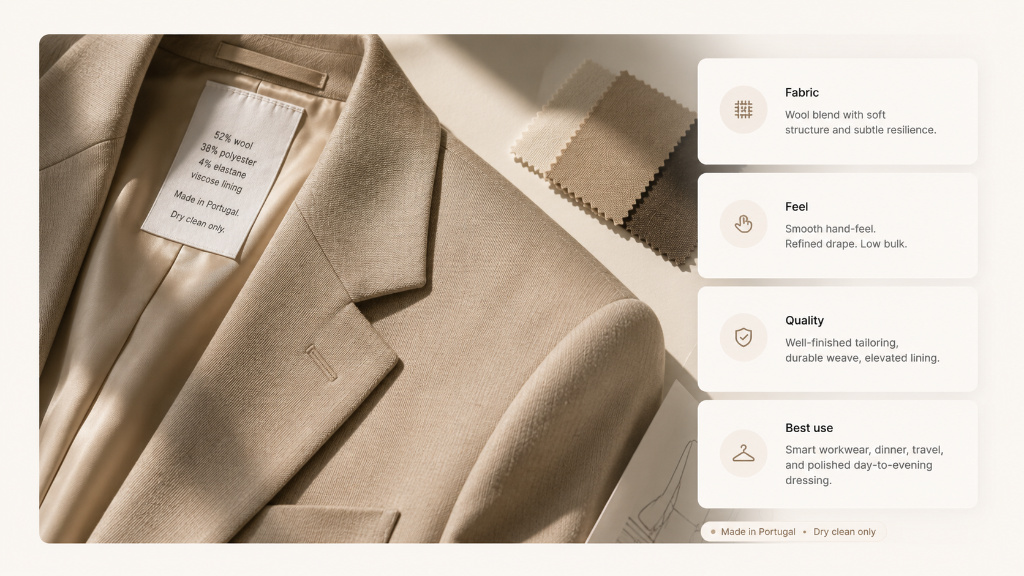
Three blazers, all priced similarly, all advertised as premium. Atelia surfaces the differences that matter.
| Max Mara, £695 | Another Tomorrow, £480 | The Frankie Shop, £295 | |
|---|---|---|---|
| composition | 68% wool, 28% mohair, 4% elastane | 72% wool, 26% viscose, 2% elastane | 60% polyester, 38% viscose, 2% elastane |
| drape | Structured with subtle sheen | Soft fluid drape, matte finish | Heavy but inelastic |
| breathability | Excellent (natural fibres) | Very good | Limited |
| durability | 9.0 / 10 | 8.2 / 10 | 6.9 / 10 |
| maintenance | Dry-clean only | Dry-clean only | Machine washable cool |
| price-value | Priced for fibre | Fair for category | Overpriced for blend |
Insulates dry warmth. Breathable. Holds shape. Ages with character. Sometimes itchy at coarser grades. Best for tailoring.
Breathable. Soft. Easily washed. Creases easily. Performance scales with weave density and finishing.
Exceptionally breathable. Creases as a feature. Loosens with wear. Built for warm weather, not formal restraint.
Luxurious hand. Temperature-regulating. Delicate. Stains visibly. High maintenance, high signal.
Fluid drape. Breathable. Derived from wood pulp. Wrinkles. Often supports natural fibres in blends.
Wrinkle-resistant. Durable. Cheap. Holds heat. Best in blends, not dominant share at premium price tiers.
The four dimensions above are the output. This is the engine that produces them. Six specialised modules, each doing one thing well, orchestrated together.
Converts messy human language into structured occasion, tone, and constraint signals.
Builds a quiet, evolving model of how each shopper actually shops, without intrusive profiling.
Enriches raw retailer data into AI-readable garment metadata across occasion, silhouette, and feel.
Translates fibre composition into lived experience. Drape, breathability, maintenance, durability.
Probabilistic comparison across competing options. Gained, sacrificed, priced.
Produces the human-readable why this. Every recommendation is grounded in traceable evidence.
Stock levels, prices, composition percentages, care labels. These are facts. They demand exact answers. Style, drape, quiet luxury, client-dinner appropriate. These are judgements. They demand probabilistic reasoning. Atelia blends both, and never confuses them.
Raw natural language from the shopper. Ambiguous, mood-led, real.
A blend of retrieval-augmented generation, specialised fashion vision, and rule-based grounding. No single model. No single vendor lock-in.
Multi-embedding catalogue index. Meaning similarity, not keyword. Updated continuously as catalogue evolves.
Frontier models orchestrated through Atelia's reasoning layer. Never raw, always grounded. Hard constraints on stock, price, size, care.
Specialised models trained on silhouette, drape, finish, and fabric recognition. Built for fashion, not photos generally.
Atelia makes no claim it cannot trace back to verifiable garment, fabric, or price data. If it cannot be grounded, it is not said.
Every verdict comes with the reasoning behind it. No black-box recommendations. The shopper sees how we got there.
We improve the shopper's ability to decide. We never decide for them. The tone is confidante, not authoritarian stylist.
Built for garments, not generic ecommerce. Trained on the way fashion is actually evaluated by people who know it.
Preference memory is opt-in, low-resolution, and never sold. We do not need to know your address to recommend a coat.
If a garment has a weakness, we say so. Atelia is not a sales tool. It is a confidence tool. Trust depends on honesty.
See Atelia read a real garment in real time, or bring your catalogue into the conversation.